Conical Diamond ATR Prisms for Process Spectroscopy
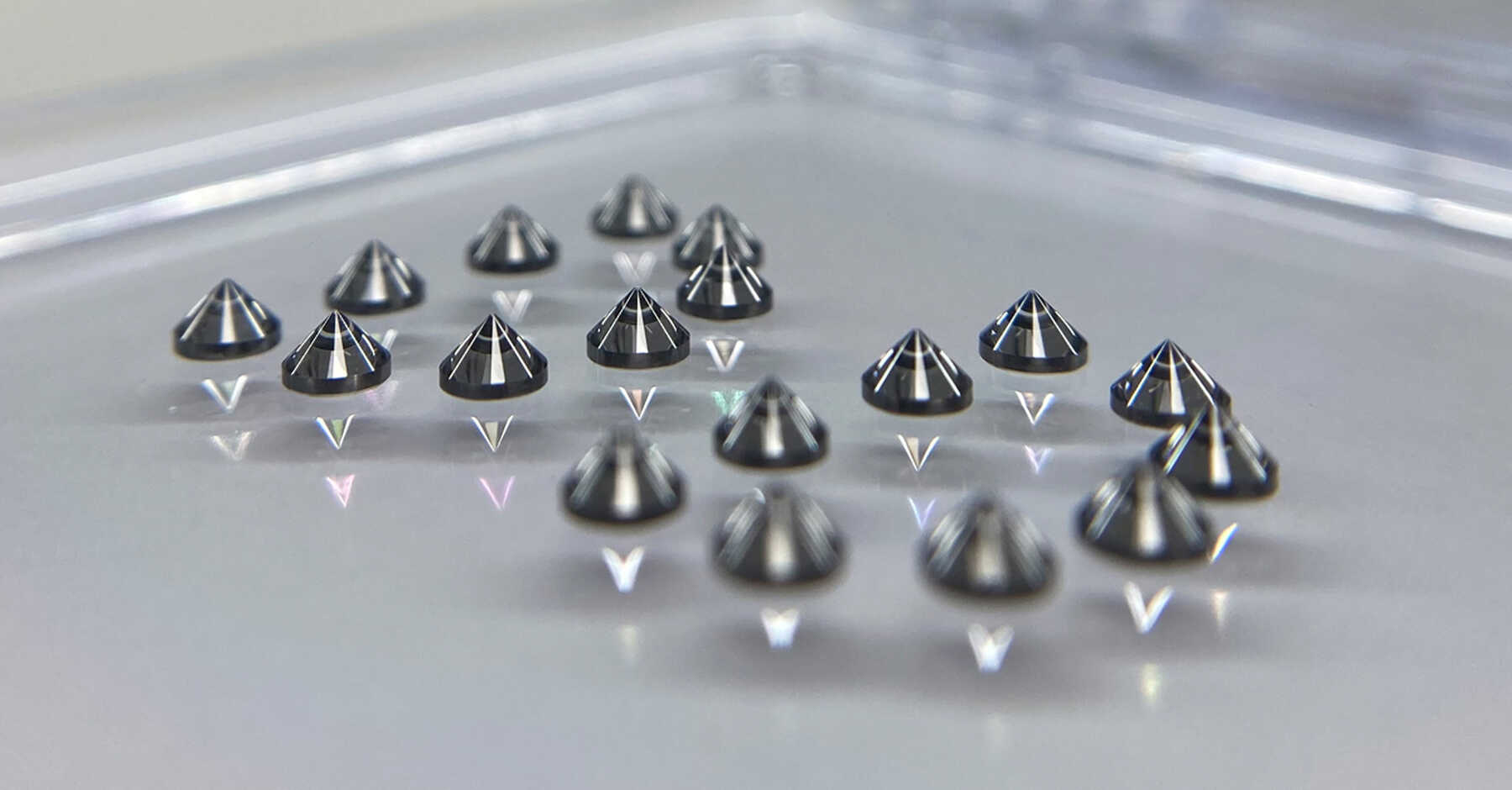
Precision Diamond Optics for Process Spectroscopy
Dutch Diamond Group develops and manufactures conical ATR prisms from carefully selected monocrystalline diamond.The conical geometry provides a durable optical interface for in situ spectroscopy and continuous process monitoring. It can be integrated directly into probes, sensors and customer specific analytical instruments.
Diamond combines broad optical transmission with exceptional hardness, chemical resistance, thermal conductivity and dimensional stability. These properties make conical diamond ATR prisms particularly suitable for measurements in demanding industrial and scientific environments.
Designed for In Situ Measurement
In conventional laboratory analysis, a sample is taken from the process and examined separately. A conical diamond ATR prism can enable measurements directly within the process environment. When the diamond surface is brought into contact with a liquid, paste, powder or other process material, the optical system can collect information about its composition and condition. This supports continuous monitoring without repeatedly removing samples for laboratory analysis.
Depending on the optical configuration, conical diamond prisms can be used across the UV, visible, near infrared and mid infrared spectral ranges.
Why Monocrystalline Diamond?
- Broad Optical Transmission
- Exceptional Wear Resistance
- High Chemical Resistance
- Excellent Thermal Conductivity
- Smooth and Durable Contact Surface
- Suitable for Aggressive Process Materials
- High Dimensional Stability
- Long Operational Lifetime
- Suitable for Cleaning and Repeated Use
Typical Applications
- Chemical Process Monitoring
- Petrochemical Analysis
- Biopharmaceutical Production
- Food and Beverage Processing
- Pharmaceutical Process Control
- In Situ IR Spectroscopy
- FTIR Process Monitoring
- UV VIS Spectroscopy
- Near Infrared Spectroscopy
- Quality Control and Material Identification
- Research and Development
- Customer Specific OEM Instruments
Customer Specific Design
Each conical diamond ATR prism can be developed according to the optical, mechanical and process requirements of the application.
- Customisation options include:
- Cone Angle and Geometry
- Overall Dimensions
- Optical Surface Quality
- Contact Surface Geometry
- Diamond Grade and Crystal Orientation
- Required Spectral Range
- Mounting Interface
- Holder Material
- Sealing Method
- Operating Temperature and Pressure
Free Standing and Mounted Components
Conical diamond prisms can be supplied as free standing components or as complete mounted assemblies. Dutch Diamond Group supports customers with material selection, optical geometry, mounting, sealing and final inspection. Holders and interfaces can be developed for direct integration into probes, sensors and OEM analytical instruments. The appropriate mounting method and holder material are selected according to the required optical performance, operating conditions and chemical environment.
From Prototype to OEM Production
We work closely with equipment manufacturers, research institutes and process technology specialists. Our engineering team can support the complete development process, from initial concept and prototype to testing, final inspection and recurring production.
Frequently Asked Questions
What is a conical diamond ATR prism?
A conical diamond ATR prism is a precision optical component used for Attenuated Total Reflectance spectroscopy. Its conical geometry can be integrated into probes, sensors and analytical instruments for direct contact with the material being analysed.
What are conical diamond ATR prisms used for?
They are used for in situ spectroscopy, continuous process monitoring, chemical analysis, quality control and material identification. Applications can be found in chemical, petrochemical, pharmaceutical, biopharmaceutical and food production.
Why is monocrystalline diamond used?
Monocrystalline diamond combines broad optical transmission with exceptional hardness, chemical resistance, thermal conductivity and dimensional stability. This makes it suitable for repeated measurements in demanding process environments.
Which spectral ranges can be used?
Depending on the diamond quality, geometry and optical system, conical diamond prisms can be used for measurements in the UV, visible, near infrared and mid infrared spectral ranges.
What is the advantage of in situ spectroscopy?
In situ spectroscopy allows material to be analysed directly within the process environment. This can provide faster information about composition and process conditions while reducing the need to remove samples for separate laboratory analysis.
Can the diamond cone be customised?
Yes. Dutch Diamond Group can adapt the dimensions, cone angle, optical surfaces, contact geometry, diamond grade and mounting interface to the requirements of the instrument and application.
Can conical diamond prisms be supplied mounted?
Yes. They can be supplied as free standing components or as mounted assemblies for integration into probes, sensors and OEM analytical instruments.
Can Dutch Diamond Group support OEM production?
Yes. Dutch Diamond Group supports customers from initial design and prototype development through testing, final inspection and recurring production.
What information is required for a quotation?
Please provide the required geometry, dimensions, spectral range, operating temperature, pressure, process material, chemical environment, mounting requirements and expected quantities. A drawing of the component or instrument interface is helpful.